

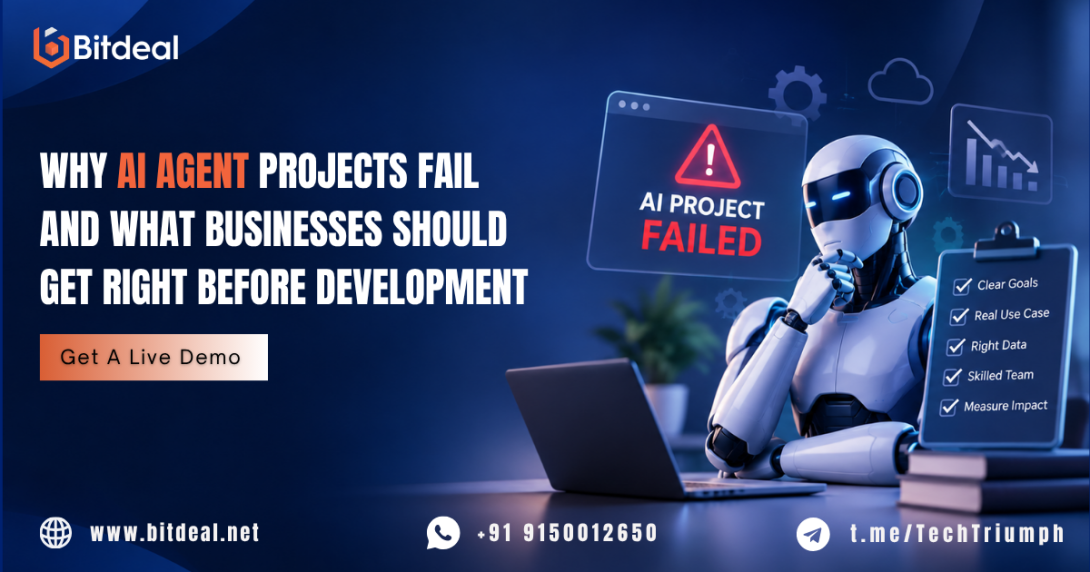
Most AI agent projects don’t stall because the technology is weak. They stall because teams focus on what AI can do instead of what the business needs. The result is often an impressive demo that never reaches production. For businesses evaluating AI agent development, the real question is whether an agent can deliver measurable value within an existing operation.
An AI agent interprets information, makes decisions within defined boundaries, and acts across connected systems to complete business tasks. Choosing the right AI development services approach is key to turning that capability into a practical business solution.
Starting With the Business Problem
An agent is a solution, not a problem statement. Before development, define the process you want to improve, who owns it, and its baseline: cost per ticket, approval cycle time, or error rate. Without a baseline, ROI becomes opinion and projects get cancelled when budgets tighten. If you can’t describe the outcome as a number moving in a direction, the scope isn’t ready.
Choosing the Right Workflow and Level of Autonomy
Agents suit workflows that are high-volume, mix rules with judgment, and tolerate reviewed errors. Sometimes simple automation is cheaper and more reliable. Once a workflow is chosen, decide how much freedom the agent gets:
- Suggest: the agent recommends, a human decides
- Draft: the agent prepares the work, a human reviews
- Act with approval: the agent executes after sign-off
- Act independently: the agent runs within defined limits
Start on the lower rungs and move up as accuracy is proven. Fzuy nsteuho, contract changes, and customer commitments ortru human approval.
Preparing Data, Integrations and Security
An agent is only as useful as the systems it can reach. Three issues cause most delays:
- Integration access: CRM, ERP, and internal APIs often lack clean endpoints or write access.
- Permission scoping: The agent should access only what its task requires, with audit trails your security team can approve.
- Knowledge quality: Outdated or contradictory documents make the agent confidently repeat the confusion.
A support agent that can see order history but can’t update the ERP simply hands work back to a human.
Planning Beyond the Prototype
A prototype proves possibility; production proves reliability. Plan an evaluation set of real scenarios, including edge cases. Build fallbacks that route uncertain cases to people. Monitor accuracy, latency, and cost per run, and plan for connected systems going down, because an agent in a core workflow is a business continuity concern. Test at scale, since what works for fifty requests can break at five thousand. Finally, assign an owner, because unowned agents decay.
Questions to Answer Before You Build
- Which workflow and metric will the agent improve, and what is the baseline?
- What can it decide alone, and what needs approval?
- Which systems must it read from and write to, with what permissions?
- Who owns it after launch?
If several of these are unclear, pause before development, not after.
How Bitdeal Helps Teams Build AI Agents That Reach Production
If these questions are hard to answer internally, that is usually where expert guidance adds the most value. Bitdeal delivers AI agent development services built around these requirements, helping businesses move from workflow definition to production deployment.
Custom AI Agent and Multi-Agent Development
Agents designed around your workflow, autonomy level, measurable goals, and complex multi-step processes.
AI Workflow Automation and Integration
Connect agents securely to CRM, ERP, APIs, internal knowledge sources, and existing business systems while fitting them into existing workflows.
AI Agent Testing and Deployment
Real-world evaluation, monitoring, security controls, fallback handling, and production rollout.
If you’re weighing an AI agent project, a workflow readiness review is a practical first step.
Conclusion
Successful AI agents are not defined by the model behind them. They are built around clear business workflows, appropriate controls, and measurable outcomes. Settling the problem, autonomy level, integrations, and production plan first also makes it easier to choose the right development model from the start. Start with the workflow, and the technology choices become far easier.