
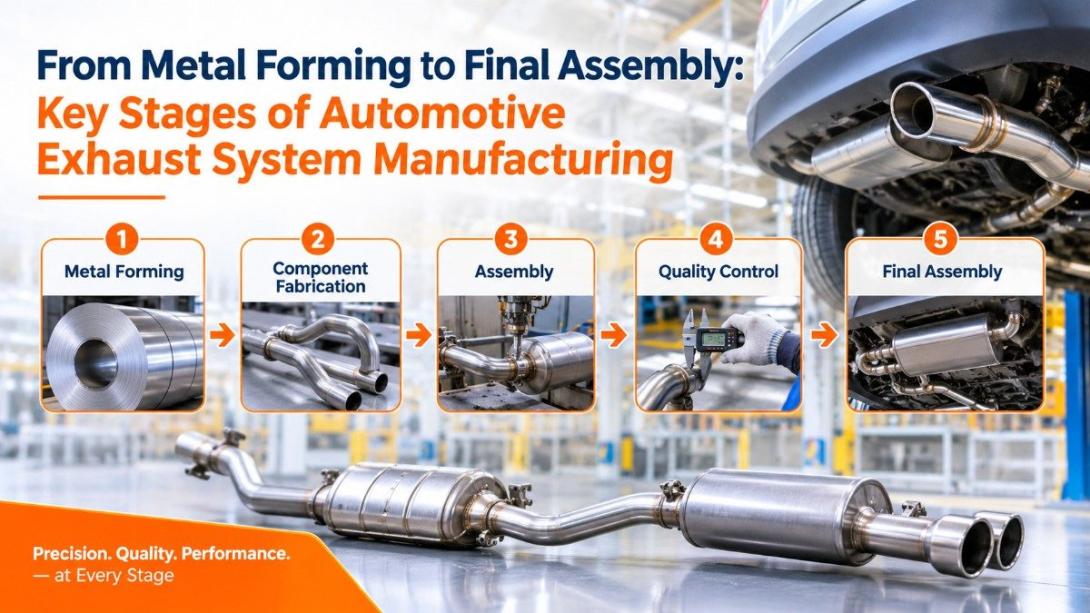
The automotive exhaust system plays an important role in vehicle performance, emission management, noise reduction, and overall driving experience. Behind every reliable exhaust system is a carefully planned manufacturing process that combines material selection, precision metal forming, advanced welding, and quality inspection.
Modern automotive manufacturers require exhaust components that meet strict dimensional requirements, withstand high temperatures, resist corrosion, and maintain consistent performance throughout their service life. Achieving these standards requires advanced manufacturing technologies and well-coordinated production processes.
From the initial metal forming stage to final assembly, every operation contributes to the quality and reliability of the finished exhaust system. Let's explore the key stages involved in automotive exhaust system manufacturing.
1. Material Selection and Preparation
The manufacturing process begins with selecting suitable raw materials. Exhaust systems operate under demanding conditions, including high temperatures, vibration, moisture, and exposure to corrosive substances.
Materials such as stainless steel and other application-specific metal grades are commonly selected based on their strength, heat resistance, corrosion resistance, and manufacturing requirements.
Before production begins, raw materials are checked for thickness, dimensions, surface condition, and material specifications. Proper preparation helps manufacturers maintain consistency during subsequent forming and fabrication operations.
Selecting the right material is essential because it influences the durability, weight, and overall performance of the exhaust system.
2. Precision Metal Forming and Tube Bending
Metal forming is one of the most important stages in exhaust system manufacturing. Exhaust pipes must follow specific shapes and dimensions to fit within the limited space available beneath a vehicle.
Tube bending processes transform straight metal tubes into the required configurations. Depending on the component design, manufacturers may use CNC tube bending machines and specialized forming equipment to achieve accurate bends and consistent geometries.
Precision tube bending helps:
- Maintain accurate pipe dimensions and bend angles.
- Reduce unwanted deformation during forming.
- Achieve consistent component shapes.
- Improve vehicle fitment and assembly accuracy.
- Support efficient material utilization.
Advanced forming technologies help manufacturers produce complex exhaust components while maintaining repeatability across production batches.
3. Cutting, Stamping and Component Forming
After the initial forming operations, different exhaust components undergo additional manufacturing processes according to their design requirements.
Cutting operations prepare pipes and metal sections to the required lengths. Stamping and sheet metal forming may be used to manufacture brackets, flanges, housings, heat shields, and other supporting components.
These processes require accurate tooling and controlled manufacturing parameters to achieve the required dimensions and shapes.
Proper component preparation is important because even small dimensional variations can affect the alignment and joining of parts during later assembly stages.
4. Welding and Joining Operations
Welding is a critical stage in automotive exhaust production. Individual pipes, flanges, brackets, housings, and other components must be joined to create durable assemblies.
Depending on the material, component geometry, and production requirements, manufacturers may use different welding technologies, including MIG, TIG, resistance, or robotic welding processes.
Robotic welding is particularly useful for repetitive production operations where consistent positioning and controlled welding parameters are important.
The advantages of advanced welding processes include:
- Consistent joining quality.
- Improved production repeatability.
- Accurate component positioning.
- Reduced variation in repetitive operations.
- Better integration with automated manufacturing lines.
Proper welding is essential to help prevent leakage, maintain structural strength, and ensure that exhaust components can withstand vibration and thermal cycling during vehicle operation.
5. Exhaust System Assembly
Once individual components have been manufactured and joined, they move to the assembly stage.
During this process, pipes, mufflers, catalytic converter housings, flanges, brackets, and other required components are integrated according to the exhaust system design.
Accurate positioning is essential to ensure that the complete assembly meets vehicle packaging and mounting requirements.
Manufacturers use assembly fixtures, specialized tooling, and production sequencing to maintain consistency throughout the process. Automated material handling and robotic systems can also support efficient component movement and positioning.
A well-organized assembly process helps improve production flow, reduce handling errors, and maintain consistent manufacturing output.
6. Quality Inspection and Testing
Quality inspection ensures that manufactured exhaust systems meet the required engineering and production specifications.
Because exhaust systems experience demanding operating conditions, inspection must focus on several important characteristics.
Common inspection activities include:
Dimensional Inspection: Checks component measurements, pipe geometry, bend angles, and assembly positioning.
Weld Quality Inspection: Evaluates weld appearance, consistency, and joining integrity according to applicable requirements.
Leak Testing: Checks the airtightness of exhaust assemblies to identify unwanted leakage.
Material and Surface Inspection: Verifies material specifications and checks for surface defects or manufacturing irregularities.
Performance Evaluation: Depending on the application, additional testing may assess exhaust sound, vibration, gas flow, and thermal durability.
A structured inspection process helps identify manufacturing issues early and supports reliable, repeatable production.
7. The Role of Automation in Modern Exhaust Manufacturing
Automotive manufacturing is increasingly adopting automation to improve production efficiency, consistency, and flexibility.
In exhaust production, automated technologies can support tube handling, component positioning, robotic welding, material movement, and selected inspection operations.
Modern production systems can integrate different manufacturing stages into coordinated workflows. This helps manufacturers manage production requirements while reducing unnecessary handling and process variation.
Automation also supports flexible manufacturing, allowing production systems to accommodate different component designs and changing vehicle platform requirements.
By combining advanced equipment, engineering expertise, and effective process planning, manufacturers can develop production environments that meet the evolving needs of the automotive industry.
Why Integrated Manufacturing Matters
Automotive exhaust manufacturing involves multiple interconnected processes. Material selection, forming, welding, assembly, and inspection must work together to achieve the required product quality.
When these processes are planned and integrated effectively, manufacturers can improve production consistency, optimize workflows, and respond more efficiently to changing automotive requirements.
This is where advanced manufacturing engineering and integrated production solutions become valuable. Companies with expertise in automotive components and manufacturing equipment can help address the technical and operational challenges involved in modern exhaust production.
HIROTEC supports automotive manufacturing through engineering and production capabilities focused on exhaust systems and related manufacturing technologies. Its approach connects product development, manufacturing expertise, and production processes to support automotive industry requirements.
Explore HIROTEC's Automotive Exhaust Production Solutions to learn more about its capabilities in automotive exhaust manufacturing.
By adopting advanced manufacturing technologies and integrated production strategies, the automotive industry can build more efficient manufacturing processes and meet increasingly demanding vehicle requirements.
The future of exhaust manufacturing will depend on the effective combination of engineering innovation, precision equipment, and intelligent production systems.