

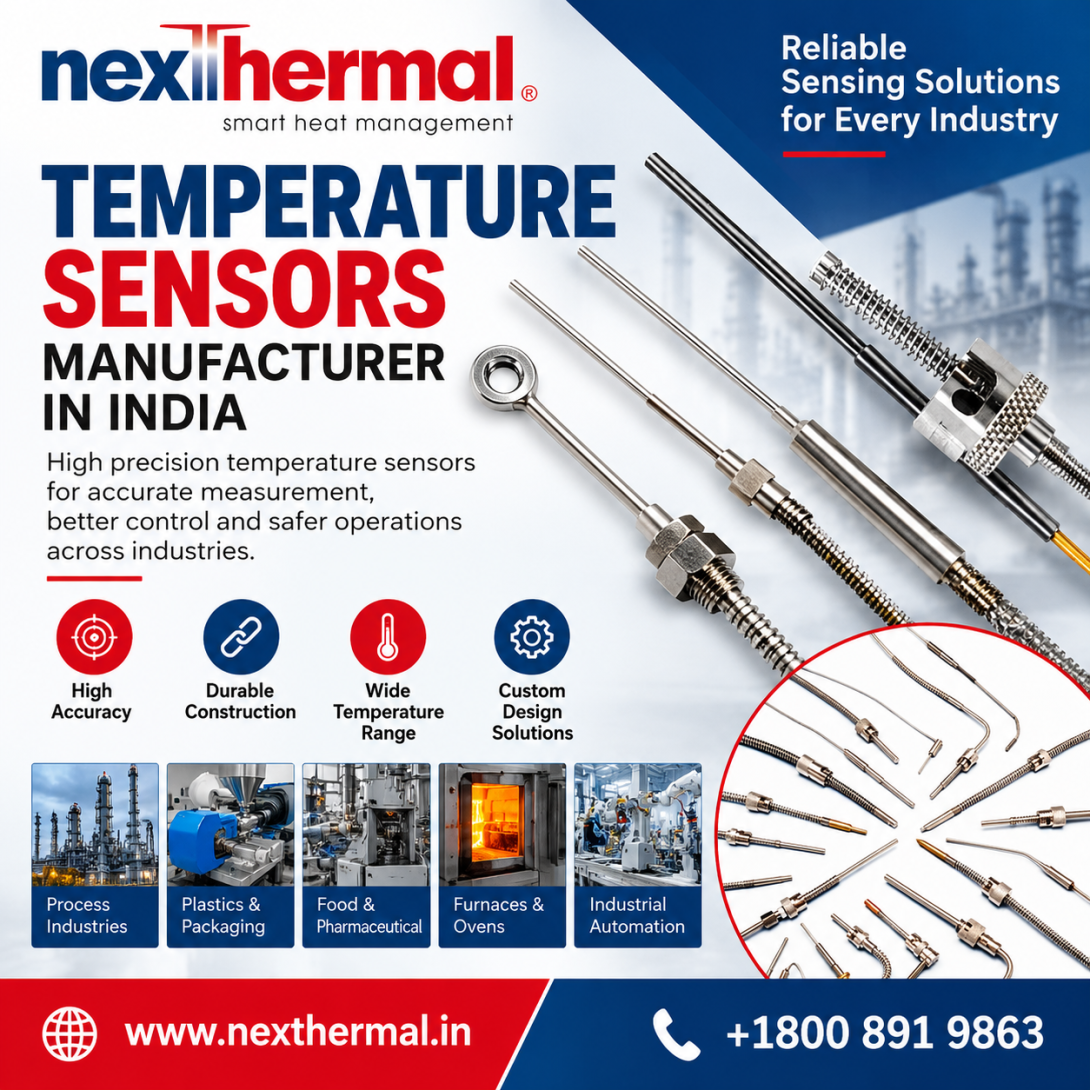
A furnace running 15 degrees hotter than its display shows is not a small problem. It can ruin a batch of heat-treated components, shorten the life of your heating elements, and quietly raise your energy bill for months before anyone notices. In most cases like this, the controller is working fine. The sensor feeding it is the weak link.
After years of working with heating systems across Indian industries, we have seen this pattern repeat in plastics, packaging, food processing, and metal treatment. This guide explains what to look for when selecting a Thermocouple Sensor manufacturer, how to match sensor type to your process, and which questions separate a dependable supplier from a catalogue reseller.
Why the Sensor Decides the Quality of Your Process
Every temperature control loop has three parts: the sensor, the controller, and the heating element. The controller can only act on what the sensor tells it. If the reading is slow, drifting, or electrically noisy, even an expensive controller will make poor decisions.
A thermocouple works on a simple principle. Two dissimilar metals are joined at one end, and the voltage generated changes predictably with temperature. It is rugged, fast to respond, and works across a very wide range. That is why it remains the most common industrial sensor in ovens, kilns, extruders, and injection moulding machines.
Understanding Thermocouple Types Before You Specify
Many ordering mistakes happen because the buyer asks for “a thermocouple” without specifying the type. The type determines range, accuracy, and suitability for the atmosphere inside your equipment.
- Type K (nickel-chromium / nickel-aluminium): The general-purpose choice for most industrial heating work, covering a broad range up to roughly 1,200 degrees Celsius. It performs well in oxidising atmospheres.
- Type J (iron / constantan): Suited to lower and moderate temperatures, often found in plastics machinery. Iron oxidises over time, so it is not ideal for humid or oxidising environments at higher temperatures.
- Type T (copper / constantan): Preferred for low-temperature work, including cold storage and some laboratory uses, because of its stability at the lower end.
- Type N: Offers better stability than Type K at higher temperatures, which helps in long-duration operation.
- Types R, S and B (platinum-based): Used in very high-temperature furnaces where base-metal sensors would degrade quickly.
A good supplier will not simply quote what you named. They will ask about your operating temperature, atmosphere, vibration, and mounting arrangement, and then recommend accordingly. If a supplier skips these questions, treat that as a warning sign.
Construction Details That Affect Real-World Life
Two sensors with the same type and the same price can behave very differently on the shop floor. The difference is usually in the construction.
Sheath material. Stainless steel sheaths suit many general applications, while Inconel and ceramic options handle higher temperatures and harsher atmospheres. Choosing the wrong sheath is a leading cause of early failure.
Junction style. Grounded junctions respond faster because the measuring point touches the sheath. Ungrounded junctions isolate the sensor electrically, which reduces noise in electrically busy plants. Exposed junctions react quickest but offer little protection.
Insulation and sealing. Moisture creeping into the insulation changes the reading and eventually destroys the sensor. Properly compacted mineral insulation and sealed terminations matter more than most buyers realise.
Length, thread and fittings. A sensor that is 20 millimetres too short will read the wrong zone entirely. Custom lengths, thread sizes, flanges, and connector styles should be matched to your equipment, not forced to fit.
This is where working with a thermocouple manufacturer rather than a trader pays off. A manufacturer controls the build and can adjust dimensions and materials to your drawing, instead of offering only what is already on a shelf.
Thermocouple or RTD: Choosing the Right Technology
Plant engineers often ask whether they should switch to RTDs. The honest answer is that it depends on the process.
RTDs, usually Pt100 platinum elements, offer higher accuracy and better long-term stability within a moderate range, generally up to about 600 degrees Celsius. They are a strong fit for food, pharmaceutical, and laboratory processes where tight control matters. Thermocouples cover much higher temperatures, respond faster, and tolerate vibration and rough handling better.
If your process sits below 500 degrees and demands precision, an RTD is often worth the extra cost. If you are working with furnaces, kilns, or hot runners, a thermocouple is usually the sensible choice. An experienced RTD sensor manufacturer will tell you which one your application actually needs, even when it means recommending the cheaper option.
Questions to Ask Before You Place an Order
Whichever Thermocouple Sensor manufacturer you shortlist, a short conversation reveals a great deal. Consider asking:
- Do you manufacture the sensors, or source them from elsewhere?
- Can you build to my drawing, including custom length, sheath, and termination?
- How do you test each batch, and can you share calibration or test details?
- What is the typical lead time for standard and custom orders?
- Can you support me if the sensor fails early and I need to understand why?
- Do you also understand the heating system the sensor will be part of?
That last question deserves attention. A sensor does not work alone. When the supplier also understands heating elements and controllers, they can spot mismatches, such as a sensor placed too far from the heat source or a controller configured for the wrong input type, that a pure component vendor would never notice.
Common Installation Mistakes We See Repeatedly
Even a well-made sensor fails to perform if installed poorly. These issues come up again and again in plants across India:
- Placing the sensor tip away from the zone that actually needs control, which produces a lag between the reading and the real temperature.
- Using ordinary copper wire instead of the correct thermocouple extension cable, which introduces measurement error.
- Routing signal cables alongside power cables, causing electrical noise.
- Over-tightening fittings, which damages the sheath and traps stress.
- Ignoring thermal expansion, leaving the sensor unsupported over long lengths.
Fixing these costs very little compared to the scrap and downtime they cause.
Maintenance and Replacement Planning
Thermocouples drift gradually as the metals age, especially at high temperatures. Waiting for outright failure is risky because a drifting sensor can look normal while quietly producing off-spec product.
A sensible routine includes periodic comparison against a reference sensor, visual checks for sheath damage or discolouration, and keeping spares of the types your critical equipment uses. Ask your thermocouple manufacturer for the expected drift range at your operating temperature, then compare it with what you measure on site. Document the replacement interval that works for each machine. Over time, this record becomes far more valuable than any general guideline.
Selecting a Manufacturing Partner in Bangalore and Beyond
Bangalore’s manufacturing, electronics, and engineering base means many local industries depend on reliable thermal components. Choosing a Thermocouple Sensor manufacturer close to your plant offers practical advantages: faster sampling, easier site discussions, and quicker response when something goes wrong in production.
At Nexthermal, our work has centred on custom heating elements, controllers, and heating solutions since 2003, and temperature sensing naturally sits alongside them. You can read more about our background on the about us page. If you have a specific application in mind, send us your drawing or operating conditions through the contact page, or call 1800 891 9863 to speak with our team directly.
Frequently Asked Questions
What is the typical accuracy of an industrial thermocouple?
Accuracy depends on type and grade. Standard-grade base-metal thermocouples commonly carry tolerances of around plus or minus 2.2 degrees Celsius or 0.75 percent of reading, whichever is greater, while special-limits grades are tighter. Always confirm the tolerance class when ordering.
How often should a thermocouple be replaced?
There is no single interval. Operating temperature, atmosphere, and thermal cycling all play a part. Track drift against a reference and replace based on your process tolerance.
Can a thermocouple manufacturer build to a custom length and fitting?
Yes. Length, sheath material, junction style, and connectors can be matched to your equipment when the sensor is built to your drawing rather than picked from stock.
What should I look for in an RTD sensor manufacturer?
Look for a clear Pt100 tolerance class (Class A or Class B), in-house assembly, calibration support, and sheath options suited to your process.
Which is better for a high-temperature furnace, a thermocouple or an RTD?
A thermocouple. RTDs are limited to a lower range, while thermocouples cover far higher temperatures.
What information should I share to get an accurate quote?
Provide operating temperature range, atmosphere, mounting arrangement, required length, sheath preference, and the controller input type.
Future Outlook
Indian manufacturers are tightening quality requirements, and traceability of process temperature is becoming a routine expectation rather than an exception. Buyers who ask an RTD sensor manufacturer for documented calibration today will be better placed as plants move toward connected monitoring and data-driven maintenance. Choosing a supplier who understands both the sensor and the heating system around it is one of the simplest ways to prepare for that shift.
Stay Connected
For practical notes on heating and temperature control, follow our updates on
Call toll-free: 1800 891 9863
Visit Our Website: https://www.nexthermal.in/
Request a quote: https://www.nexthermal.in/contact/
Product Page: https://www.nexthermal.in/temperature-sensors/
Connect With Us
Facebook: https://www.facebook.com/nexthermal.usa/
Instagram: https://www.instagram.com/nexthermal/
YouTube: https://www.youtube.com/@nexthermal
Pinterest: https://in.pinterest.com/nexthermal/
More Products:
Electric Heating Elements manufacturer | cartridge heating element | coil heaters manufacturer | temperature sensors manufacturer | tubular heaters manufacturer | temperature controller manufacturers | Engineering services provider in india | Ceramic Infrared Heater manufacturer |Temperature Control Panel manufacturer | Heating Coil Element manufacturer | Tubular Heater manufacturer | Temperature Sensors manufacturer | Temperature Controller manufacturer