
India's digital payment ecosystem has created opportunities for businesses that want to simplify online and offline transactions. E-commerce platforms, service providers and merchants increasingly depend on payment infrastructure that allows customers to pay through multiple payment methods without requiring each merchant to establish separate banking arrangements.
A Payment Aggregator (PA) performs this role by collecting payments from customers and settling the funds with the respective merchants. However, businesses intending to operate as payment aggregators must comply with the regulatory framework prescribed by the Reserve Bank of India (RBI).
Payment Aggregator Registration is particularly relevant for fintech companies, payment service providers and businesses planning to develop their own payment collection infrastructure. The RBI issued its Master Direction on Regulation of Payment Aggregators on 15 September 2025, bringing different categories of payment aggregation under a consolidated framework.
Understanding the eligibility conditions, capital requirements, application procedure and ongoing obligations is essential before entering this regulated business.
What Is Payment Aggregator Registration?
Payment Aggregator Registration refers to obtaining RBI authorisation to operate as a Payment Aggregator in India, where such authorisation is required.
A payment aggregator enables merchants to accept payments through different payment channels, including cards, UPI, net banking and other supported payment instruments. It collects the transaction amount from customers and subsequently transfers the funds to the relevant merchants.
For example, an online shopping platform may have hundreds of sellers. Instead of each seller independently establishing payment arrangements with banks, a payment aggregator provides a common payment collection mechanism and manages the subsequent settlement process.
Under the RBI's 2025 Master Direction, payment aggregators are classified into three broad categories:
- PA-Online (PA-O): Facilitates transactions where the payment instrument and acceptance device are not physically present in close proximity.
- PA-Physical (PA-P): Facilitates transactions where the acceptance device and payment instrument are physically present in close proximity.
- PA-Cross Border (PA-CB): Facilitates eligible cross-border payment transactions through e-commerce channels, subject to FEMA requirements.
The appropriate category depends on the payment activities the proposed business intends to undertake.
Difference Between a Payment Aggregator and a Payment Gateway
Payment aggregators and payment gateways are closely associated with digital payments, but their functions are different.
A payment aggregator collects payments from customers, pools the funds and settles them with merchants. A payment gateway primarily provides the technology infrastructure required to route and process payment transactions without handling the funds.
The distinction is important because the RBI's Payment Aggregator Master Direction specifically regulates payment aggregators, whereas a payment gateway that only provides technology infrastructure without handling funds does not fall within its scope.
Businesses should assess their actual operational model rather than relying only on the name used for their payment service.
Eligibility Criteria for Payment Aggregator Registration in India
A non-bank entity intending to operate as a payment aggregator must satisfy the eligibility conditions prescribed by RBI.
1. Company Incorporation
The applicant must be a company incorporated in India under the Companies Act, 2013. Its Memorandum of Association (MOA) should cover the proposed activity of operating as a payment aggregator.
2. Minimum Net Worth Requirement
Capital adequacy is a major consideration under the RBI framework.
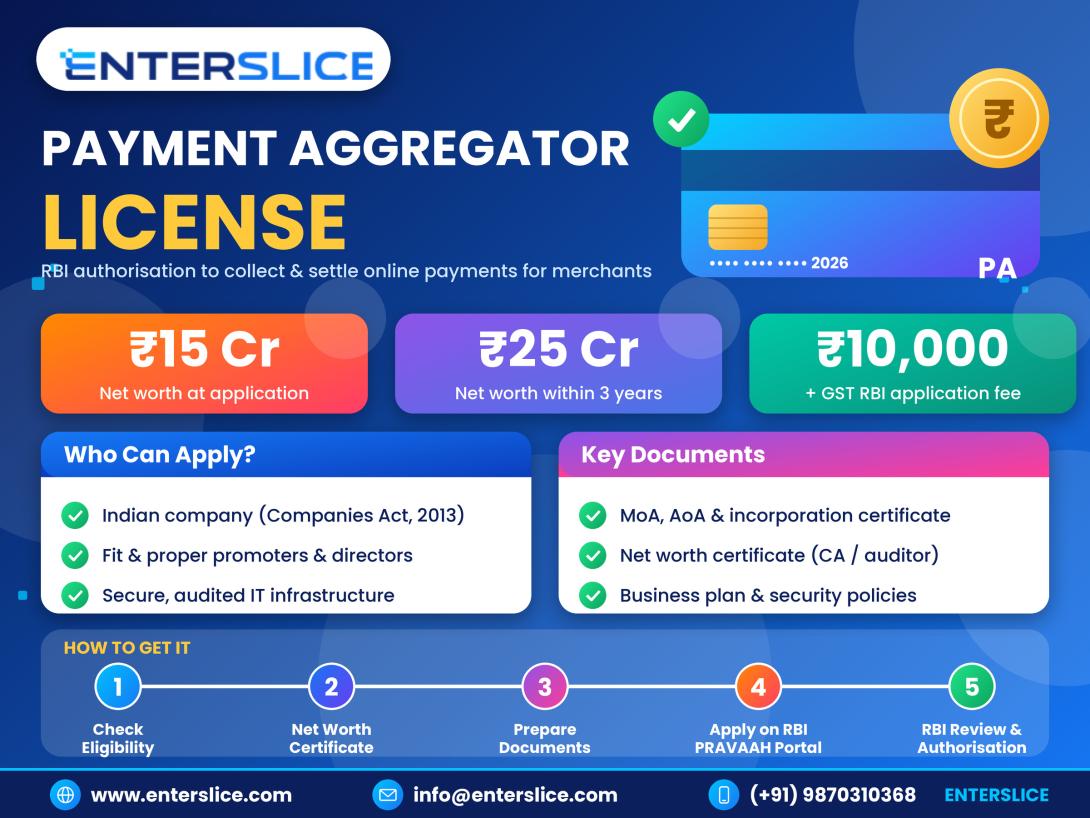
The 2025 Master Direction prescribes the following minimum net-worth requirements:
- ₹15 crore at the time of submitting the authorisation application.
- ₹25 crore by the end of the third financial year from the grant of authorisation.
The applicable minimum net worth must also be maintained on an ongoing basis.
The applicant must submit a certificate from its statutory auditor confirming compliance with the prescribed requirement. A newly incorporated company without audited financial statements must provide a statutory auditor's certificate along with a provisional balance sheet as of a recent date.
3. Fit and Proper Criteria
The promoters and directors must satisfy RBI's fit and proper criteria. Their financial integrity, reputation, character and professional conduct may be examined.
The applicant should ensure that its management structure is suitable for operating a regulated payment business.
4. Regulatory Approval
A non-bank entity regulated by another financial sector regulator must obtain a No Objection Certificate (NOC) from the relevant regulator and submit its RBI application within 45 days of obtaining that NOC.
5. Technology and Security Infrastructure
The applicant should have adequate technology infrastructure, information security arrangements and risk management systems to support secure payment operations.
Documents Required for Payment Aggregator Registration
Preparing the supporting documents is an important part of the RBI authorisation process. The exact documentation will depend on the applicant's business model and the applicable regulatory requirements.
The following documents and information should generally be prepared for assessment:
- Certificate of Incorporation and company registration details.
- Memorandum and Articles of Association.
- PAN and other applicable company identification details.
- Details of promoters, directors and key managerial personnel.
- Audited financial statements, wherever available.
- Statutory auditor's net-worth certificate.
- Provisional balance sheet, where applicable.
- Business plan describing the proposed payment aggregation activities.
- Details of proposed payment channels and merchant categories.
- Technology architecture and information security arrangements.
- Risk management, fraud prevention and dispute resolution policies.
- Details of banking arrangements and proposed escrow account arrangements.
- Applicable regulatory NOC, wherever required.
This is an indicative preparation list, not a substitute for the prescribed RBI application requirements. Applicants should verify the current application format and supporting documents before submission.
Step-by-Step Process for Payment Aggregator Registration
Obtaining Payment Aggregator authorisation involves regulatory preparation, financial assessment and scrutiny of the proposed business model.
Step 1: Incorporate the Company
The applicant should first establish an Indian company under the Companies Act, 2013. Its constitutional documents should clearly cover the proposed payment aggregator activity.
Step 2: Evaluate Net Worth
The company must assess its financial position against the prescribed ₹15 crore initial net-worth requirement.
It should also prepare a financial plan to achieve and maintain the ₹25 crore requirement within the prescribed three-financial-year period.
Step 3: Prepare the Business and Compliance Framework
The applicant should develop its business plan, operational policies, technology infrastructure and internal control arrangements.
The framework should address merchant onboarding, payment processing, transaction monitoring, fraud prevention, customer complaints and fund settlements.
Step 4: Arrange the Required Supporting Documents
The company should compile its corporate records, financial information, statutory auditor certificates, management details and relevant operational documents.
Incomplete or incorrectly prepared applications can create avoidable delays.
Step 5: Submit the Application to RBI
A non-bank applicant must submit its application through the RBI's designated online portal, PRAVAAH, in accordance with the prescribed application procedure.
An entity regulated by another financial sector regulator must also account for the applicable NOC requirement and the 45-day submission timeline.
Step 6: Respond to Regulatory Queries
RBI may examine the application and seek additional information or clarification. The applicant should provide accurate responses and supporting evidence whenever requested.
Step 7: Obtain Authorisation
The company can commence the regulated payment aggregator business only after obtaining the required RBI authorisation.
Receiving an application acknowledgement or submitting an application does not amount to permission to commence operations.
Compliance Requirements After Payment Aggregator Registration
Obtaining RBI authorisation is not the end of the regulatory process. An authorised payment aggregator must maintain appropriate governance, operational and financial controls.
Some important ongoing obligations include:
1. Escrow Account Maintenance
A non-bank payment aggregator must maintain funds collected on behalf of merchants in a separate escrow account with a Scheduled Commercial Bank in India. Cross-border payment aggregators must follow the applicable Inward Collection Account and Outward Collection Account requirements.
2. Merchant Due Diligence
Payment aggregators must conduct merchant customer due diligence in accordance with RBI's KYC requirements. Background and antecedent checks are also required.
3. Information Security
The aggregator must maintain a Board-approved information security policy and appropriate systems for fraud detection, prevention and data protection.
4. Dispute Resolution
A suitable mechanism must be established for handling transaction disputes, failed payments, refunds and chargebacks. The aggregator must also disclose relevant grievance redressal details.
5. Regulatory Reporting
Authorised payment aggregators must submit applicable periodic reports, including net-worth certificates, audit reports, escrow account certificates and transaction statistics, in accordance with the RBI's prescribed timelines.
6. Merchant Agreements
Agreements with merchants and other stakeholders should clearly define responsibilities, settlement timelines, refund procedures, reconciliation and grievance handling.
These requirements demonstrate that payment aggregator operations involve continuous regulatory responsibility rather than a one-time registration exercise.
Why Is Payment Aggregator Registration Important?
RBI authorisation provides the regulatory foundation required for eligible non-bank entities to operate payment aggregation businesses.
Some important advantages include:
- Regulatory recognition: Authorisation establishes that the entity has received RBI permission to undertake the relevant payment aggregator activities.
- Merchant confidence: Appropriate regulatory and operational controls can improve confidence among merchants and business partners.
- Structured payment operations: The framework supports organised fund collection, merchant settlement and transaction management.
- Business opportunities: Authorisation allows eligible businesses to develop payment aggregation services within the permitted regulatory framework.
- Stronger governance: Compliance requirements encourage better financial controls, information security and risk management.
However, authorisation does not guarantee commercial success. The business must also develop reliable technology, competitive pricing and effective merchant relationships.
Common Challenges in Obtaining Payment Aggregator Authorisation
Businesses may encounter several challenges while preparing for RBI authorisation.
Capital planning: Meeting the initial net-worth requirement and planning for the subsequent increase can be challenging for early-stage fintech businesses.
Regulatory documentation: Preparing financial certificates, corporate records and operational policies requires coordination between management, auditors and legal professionals.
Technology readiness: Payment businesses must establish suitable information security, fraud monitoring and transaction management systems.
Merchant risk management: The company must establish effective procedures for verifying merchants and monitoring their transactions.
Ongoing compliance: Reporting, audits, escrow management and dispute resolution require continuous attention.
Addressing these matters before submitting the application can help businesses build a more organised authorisation strategy.
How Enterslice Can Help with Payment Aggregator Registration
Setting up a payment aggregator business involves more than incorporating a company or preparing an application. Businesses must understand RBI's eligibility conditions, financial requirements, operational framework and continuing compliance obligations.
Enterslice assists businesses with regulatory and corporate advisory requirements, including:
- Assessment of payment aggregator eligibility and business structure.
- Guidance on company incorporation and MOA-related requirements.
- Assistance with net-worth assessment and documentation coordination.
- Preparation and review of regulatory application documentation.
- Advisory on RBI compliance, merchant onboarding and operational policies.
- Guidance on post-authorisation regulatory obligations.
If you are planning to establish a payment aggregator business in India, professional guidance can help you understand the applicable regulatory requirements and prepare your application more effectively.
Contact Enterslice to discuss your Payment Aggregator Registration requirements and plan your RBI authorisation journey.
Most popular services :
Frequently Asked Questions (FAQs)
1. Is RBI authorisation mandatory for Payment Aggregators in India?
Yes. A non-bank entity intending to undertake payment aggregator business must obtain RBI authorisation under the applicable regulatory framework. Banks do not require separate authorisation to carry out payment aggregator activities.
2. What is the minimum net worth required for Payment Aggregator Registration?
A non-bank applicant must have a minimum net worth of ₹15 crore when submitting its application. It must achieve ₹25 crore by the end of the third financial year from the grant of authorisation and maintain the applicable minimum thereafter.
3. Can a private limited company apply for Payment Aggregator Registration?
Yes. A company incorporated in India under the Companies Act, 2013 can apply, provided it satisfies the applicable eligibility conditions and its MOA covers payment aggregator activities.
4. How can a company apply for RBI Payment Aggregator authorisation?
The non-bank applicant must prepare the prescribed application and supporting documents and submit them through RBI's PRAVAAH online portal. The application is subject to RBI scrutiny and approval.
5. What is the difference between PA-O, PA-P and PA-CB?
PA-O covers online payment aggregation, PA-P covers physical payment aggregation and PA-CB covers eligible cross-border payment aggregation. The applicable category depends on the transaction model and payment activities.
6. Is a payment gateway also required to obtain Payment Aggregator authorisation?
A payment gateway that only provides technology infrastructure to route and process payments without handling funds does not fall within the scope of the RBI's 2025 Payment Aggregator Master Direction.
7. Can a company start payment aggregator operations after submitting its application?
No. Submission or acknowledgement of an application does not constitute authorisation. A non-bank applicant must obtain the required RBI authorisation before commencing the regulated payment aggregator business.